
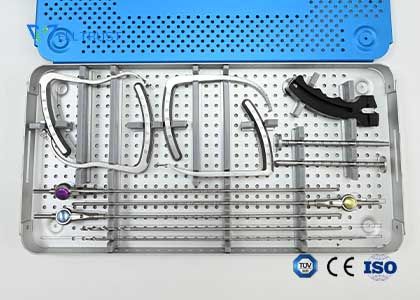
ACL surgery instruments are specialized tools used for guidewire placement, tunnel preparation, graft handling and fixation during anterior cruciate ligament reconstruction. The exact instrument list depends on the reconstruction technique, the selected implant or fixation method, the joint access requirements and the configuration of the complete instrument set.
For buyers searching for ACL surgery instruments names, the most important point is that these tools should be evaluated as a compatible system rather than as unrelated individual products. A practical configuration may include femoral and tibial guides, guide pins, cannulated drill bits, reamers, depth gauges, passing instruments and fixation-related tools.
The following groups cover the main instrument functions commonly reviewed when selecting an ACL reconstruction instrument set. Set contents vary by manufacturer and surgical technique, so the final configuration should be confirmed against the applicable product documentation.
| Instrument name | Primary function | Configuration points to confirm |
|---|---|---|
| Femoral guide | Supports positioning of the guidewire for femoral tunnel or socket preparation. | Approach, offset, aiming geometry, working length and compatible guidewire. |
| Tibial guide | Supports guidewire positioning for tibial tunnel preparation. | Angle range, aiming tip, entry-point design and compatible accessories. |
| Guide pin or guidewire | Establishes the planned pathway for a compatible drill or reamer. | Diameter, length, tip design and compatibility with the guide and drill. |
| Cannulated drill bit | Prepares a tunnel or socket over a guidewire or guide pin. | Diameter range, working length, connection and intended tunnel preparation. |
| Reamer | Enlarges or prepares a tunnel or socket according to the selected technique. | Size, cutting design, working length and compatibility with the system. |
| Depth gauge | Helps assess tunnel or socket depth where required by the technique. | Measurement range, scale, working end and system compatibility. |
| Passing instrument | Supports graft or suture passage through the prepared pathway. | Tip configuration, working length, suture compatibility and handling. |
| Fixation instrument | Supports placement of the selected fixation component. | Implant interface, driver or inserter design and matching fixation product. |
Femoral and tibial guides are used to help establish the intended guidewire direction. These instruments are not interchangeable by default because they are designed for different anatomical targets and may support different approaches. Buyers should specify whether the required configuration is for femoral positioning, tibial positioning or both.
Guide pins, cannulated drill bits and reamers are selected according to the planned tunnel or socket dimensions. A cannulated instrument must match the guidewire or guide pin and should also be compatible with the selected handle, drive or instrument system. Diameter and working length should be verified from the technical documentation rather than inferred from the product name.
Depending on the reconstruction method, the set may include passing sutures, suture-passing instruments, graft preparation tools or other accessories. The required components depend on the fixation method and the intended workflow. A set described as an ACL instrument set should therefore be reviewed to determine whether it includes only tunnel-preparation tools or also includes graft-passage and fixation accessories.
Fixation-related instruments should correspond to the selected fixation product. For example, an inserter, driver or delivery tool should be checked against the implant interface, size and placement method. When sourcing an ACL/PCL system, confirm which components are included in the standard set and which are supplied separately.
Different ACL reconstruction techniques can require different guide geometry, access instruments, drilling tools and fixation components. Before requesting a quotation, identify the intended technique and the required femoral and tibial instrument groups.
Important details include guidewire diameter, drill and reamer sizes, working lengths, guide angles, connection interfaces and the relationship between the instruments and the fixation products. Components from different systems should not be assumed to be interchangeable because they have a similar appearance.
Ask for a detailed contents list rather than relying on the general term “ACL instrument set.” The list should identify the quantity, model or reference, size options and whether each component is reusable or disposable when that information applies.
For reusable instruments, confirm the manufacturer’s cleaning, inspection, maintenance and sterilization instructions. The applicable instructions depend on the individual product and market documentation. If the set combines components with different handling requirements, those differences should be made clear before purchase.
Well Trust provides arthroscopy and sports medicine instrument options for professional medical device customers. The available range includes ACL/PCL reconstruction instrument sets, localization systems, all-inside reconstruction instruments and related arthroscopic tools.
For a configuration review, buyers can start with the ACL/PCL Cruciate Ligament Reconstruction Instrument Set, the All-Inside ACL/PCL Cruciate Ligament Reconstruction Instrument Set or the ACL/PCL All-in-One Cruciate Ligament Localization System. The appropriate product configuration should be confirmed according to the required technique, dimensions, compatibility and applicable technical documentation.
For additional background, see the related guide to ACL reconstruction instruments. That article explains the role of femoral guides, tibial guides, guide pins and cannulated drill bits in more detail.
Common names include femoral guide, tibial guide, guide pin, guidewire, cannulated drill bit, reamer, depth gauge, passing instrument and fixation instrument. The exact set contents depend on the technique and manufacturer.
A femoral guide supports positioning of a guidewire for femoral tunnel or socket preparation. Its design should match the intended technique and compatible instruments.
A femoral guide is intended to support femoral guidewire positioning, while a tibial guide supports tibial guidewire positioning. Their geometry and intended anatomical targets are different.
A set may include guides, guide pins, drills, reamers, depth gauges and other instruments for graft passage or fixation. Buyers should request the exact contents list because configurations vary.
Selection should consider the intended technique, ACL/PCL scope, instrument dimensions, guidewire and drill compatibility, fixation method, set contents, reusable or disposable status and applicable documentation.
Understanding the names and functions of ACL surgery instruments helps hospitals, distributors and medical device purchasers evaluate a complete reconstruction configuration. Femoral and tibial guides support positioning, guide pins and cannulated drills support tunnel preparation, and additional instruments may be required for graft passage and fixation. The final set should be selected by confirming the technique, dimensions, compatibility, documentation and exact contents with the manufacturer.
